Can India’s youth turn protest into political power?
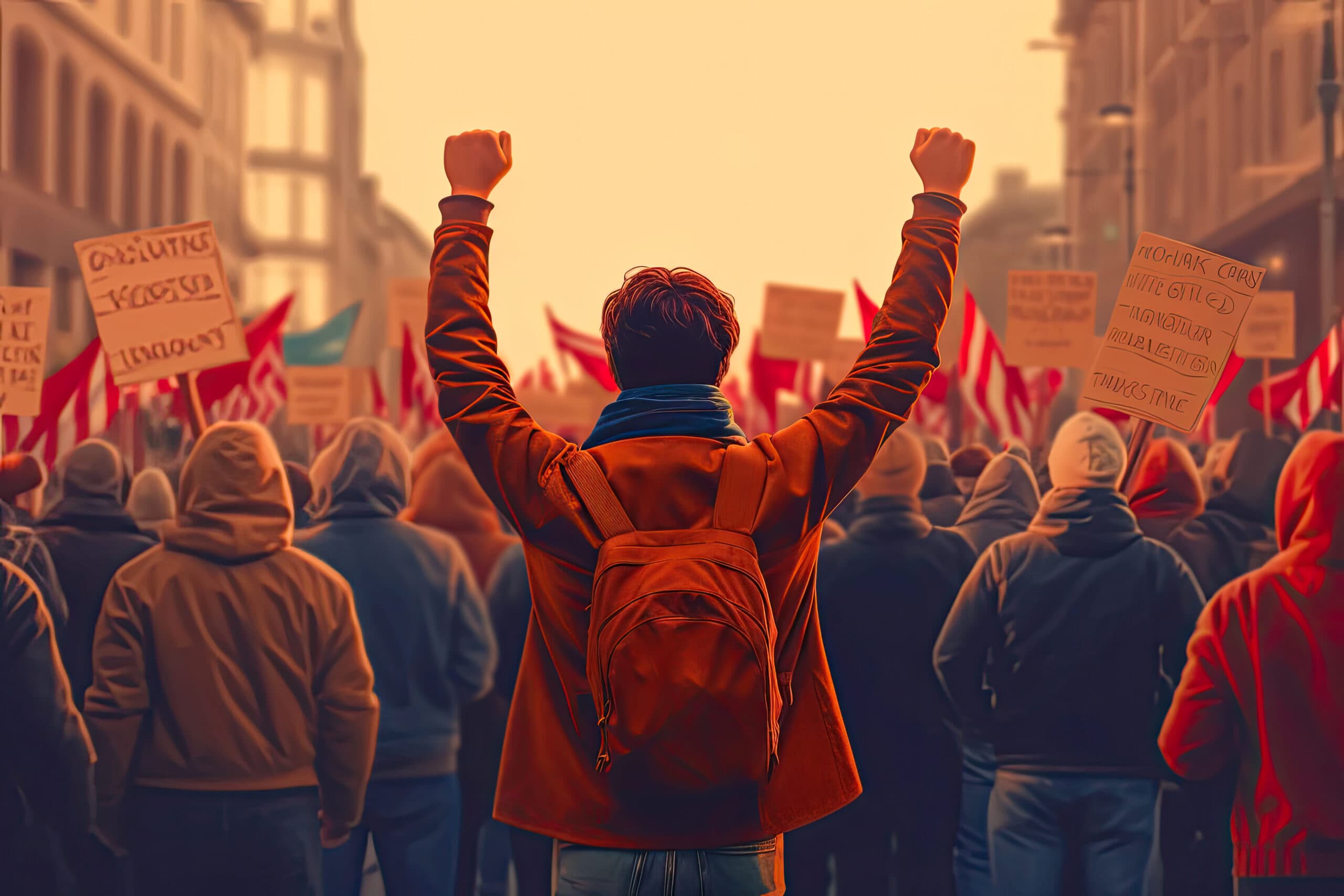
My first instinct was to understand the Cockroach Janta Party (CJP) protests through the argument I made in my essay submission to the John Locke Institute on Prime Minister Narendra Modi’s majoritarianism. In that essay on whether democracy is in crisis, I examined how the Modi government has redefined the “true nation”, placing a Hindu identity at its centre and making any other demographic of person appear less authentically Indian.
Now, I’m not sure they actually relate as much as I thought. The protests were not born from a dispute over religious identity created by majoritarian politics. The youth that gathered were not resisting the Hindutva trend or challenging the cultural boundaries of the nation; they were protesting a leaked exam paper, a broken testing system and the apparent absence of political accountability. Many had spent years preparing for an examination that promised access to medical education and, through it, a stable professional future.
Placing every confrontation with the Modi government inside the framework of majoritarianism would flatten Indian politics into a single argument. It would also obscure what makes these protests so unsettling for the established political machine in India. In this case, anger crossed all the ideological and religious lines that the government has been meticulously reinforcing. It reached students, parents, professionals and even families sympathetic to the BJP.
The Cockroach protests arose from a separate fracture in Indian democracy: the widening distance between a young, aspirational population and the institutions that control its opportunities.
The question I am left with is larger than whether Dharmendra Pradhan should have resigned. India’s young people have discovered that they can organise outside the traditional parties, withstand police force and compel a powerful government to think twice. Can that discovery grow into lasting political power, or will the older institutions of Indian politics absorb, divide and eventually outlast it?
The Straw that Broke the Camel’s Back
To understand the protests, it is necessary to understand what the National Eligibility cum Entrance Test, or NEET, represents.
NEET is the common entrance examination for undergraduate medical education across India. On 3 May 2026, around two million candidates sat the examination. The number of available MBBS places was approximately 137,000, leaving roughly one medical seat for every fifteen candidates sitting the examination. In many families, particularly those unable to afford private medical education, a high NEET rank makes several years of coaching tuition and parental sacrifice worthwhile.
Nine days after the examination, the National Testing Agency cancelled it following allegations that questions had been leaked. The Central Bureau of Investigation registered a case involving criminal conspiracy, cheating, corruption and offences under the Public Examinations Act. By late May, the CBI said it had arrested thirteen people, including educators, coaching-centre figures and individuals involved in preparing examination material. A re-test was eventually held on 21 June.
A paper being leaked is sometimes described as an administrative aberration. I don’t think, in this case, that it suffices to leave it at that. A super-bottleneck examination of this scale allocates scarce opportunities across a society of enormous inequality. It asks students to accept a brutal competition because the outcome will supposedly reflect preparation, ability and effort. Once the paper has been circulated in advance, the entire basis of that competition disappears.
Students had accepted that most of them would lose. What they could not accept was the possibility that the contest had been compromised before it began. In this way, the leak was the last straw that triggered reactions that proved the frustrating nature of education in India under the current administration.
This anger is also situated within an already difficult economic landscape for the youth of India. India’s official unemployment rate for people aged fifteen to twenty-nine was 9.9% in 2025, compared with 3.1% for the population aged fifteen and above. Among urban youth, unemployment stood at 13.6%. These figures record people actively looking for work, so they don’t fully capture underemployment, insecure employment or graduates who have stopped searching. Even within the official measure, young Indians were more than three times as likely to be unemployed as the broader working-age population.
The examination system occupies a critical place in this economy. It is a social super-bottleneck route into medicine, public employment and professional education in a labour market where secure jobs are increasingly scarce. The promise is simple: endure the competition now and social mobility may follow.
The youth protesting in New Delhi had not rejected that promise. Many had organised a significant part of their lives around it. Their anger came from having taken the state’s own promise of merit more seriously than the institutions administering it which lack that same merit even at first glance.
How an insult united a constituency
The name “Cockroach Janta Party” came from a separate institutional failure.
On 15 May, during a Supreme Court hearing concerning criticism of judges, Chief Justice of India Surya Kant compared some unemployed young people who become activists, journalists or social-media critics to “cockroaches”. Within a day, Abhijeet Dipke, a thirty-year-old political communications strategist studying at Boston University, posted a satirical question online: “what would happen if the cockroaches formed a party?”
The insult found a constituency because it described an experience many young Indians already recognised. They had been told that India’s youth were its demographic advantage, its future workforce and the carriers of its global ambitions. Yet unemployed young people who questioned powerful institutions could apparently be compared directly to pests by the educated, ‘old guard’ currently in power.
Dipke created an online sign-up form and launched the Cockroach Janta Party on 16 May. It was neither registered with the Election Commission nor structured as a conventional political party. What began as parody quickly acquired more than one lakh (100,000) sign-ups, while its Instagram following reportedly rose above two crore (20 million) people. The movement moved onto the streets in June, first through smaller demonstrations and then through a continuing sit-in at Jantar Mantar from 20 June.
This is where I think an understanding of Manuel Castells plays a role,
In his 2012 book Networks of Outrage and Hope, Castells examines movements that first take shape through communication networks rather than established parties, unions or formal leadership structures. Individuals experience anger privately. Digital networks allow them to discover that their anger is shared. A personal grievance gains a backing, a symbol and an audience. The network can then occupy physical space, turning dispersed frustration into visible collective action.
The CJP followed that movement from screen to street with unusual clarity. A judicial insult became a meme. The meme became an identity. That identity connected young people whose grievances ranged from paper leaks and unemployment to general distrust of public institutions. Those connections eventually sustained a thirty-six-day protest.
Humour was, of course, central to the process. Satire allowed protesters to challenge figures who had become insulated by office and ceremony. Memes reduced the perceived distance between an individual with a phone and an institution such as the Supreme Court, Parliament or the Union government. Ridicule made authority appear vulnerable in a way that conventional opposition has not been able to do in years.
Pratap Bhanu Mehta observed that the movement’s young organisers had “outwitted the government on Instagram”. While persuasive, I think it’s crucial to recognise the way this movement manifested outside a digital space. Instagram did give the movement pivotal reach. Its survival depended on people organising food, medical support, legal assistance, transport and communication at the protest site. Through this reach, Sonam Wangchuk’s twenty-six-day hunger strike attracted national attention. Student organisations supplied experienced organisers. Lawyers helped secure the release of detained protesters. Opposition parties amplified the issue in Parliament while, for once, remaining secondary to the movement itself.
The movement was therefore networked, but it was never purely spontaneous. It had identifiable leaders, political experience and help from older forms of organisation. That complicates any conception that social media had suddenly ‘replaced’ traditional politics.
Networks helped people assemble. It was organisation that helped them remain.
From examination failure to state-capacity failure
Milan Vaishnav’s work on Indian state capacity offers another way of understanding why the examination leak produced such widespread anger.
State capacity refers to the ability of public institutions to carry out their responsibilities consistently. A state can possess a large bureaucracy, strong police powers and an ambitious policy agenda while remaining weak at implementation. It may announce national systems that it cannot administer fairly, collect information that it cannot verify, or create laws that it cannot enforce without discrimination or delay.
Vaishnav has argued that India’s political and economic transformation has entirely outpaced the development of many public institutions. Elections have grown more competitive, the economy has expanded and citizens’ expectations have risen. However, basic administrative systems have struggled to keep pace on urban, and especially rural, scales.
NEET exemplifies this problem. The Union government has created a single examination that controls admission to medical institutions across the country. Centralisation promises consistency. It also concentrates risk. When one paper is compromised, the consequences spread across millions of households.
The government had already enacted the Public Examinations (Prevention of Unfair Means) Act in 2024. Yet a major leak occurred just two years later. Following the protests, the government proposed longer prison terms, larger fines, fast-track courts and an examination-reform task force. These responses may deter criminal networks, however, they do not resolve the deeper institutional question: why did a system governing the futures of millions require a national uprising before accountability reached the ministerial level?
Indian governments are often judged by the scale of their ambitions. The CJP protests demanded that they also be judged by the reliability of their institutions and the accountability they are willing to take.
A government that can conduct elections for nearly a billion voters in the most expensive elections in the world, build digital infrastructure and centralise national examinations cannot invoke complexity only when its systems fail. Administrative difficulty may explain some failure, but it can never erase responsibility for it.
What majoritarianism explains, and what it does not
At this point, I return to my earlier argument about Modi’s majoritarianism, but with a clearer sense of its core limits.
Christophe Jaffrelot has described India’s movement towards an ethnic democracy, a system in which elections continue while the identity of the religious majority becomes increasingly fused with the nation. Under this political imagination, Hindu culture occupies the centre of Indian identity and minorities participate from a less secure position. The ruling party gains further authority by presenting itself as the most authentic representative of the majority and, through it, of India.
That framework remains important to any broader evaluation of Indian democracy, but it does not quite explain why the Cockroach movement began.
The examination leak did not divide citizens according to religion. Fairness in education troubled BJP supporters as well as government critics. The protesters marched with the national flag, copies of the Constitution and images of Ambedkar, Gandhi and Bhagat Singh. Their demand was only ministerial responsibility and examination reform.
The movement therefore emerged from the developmental side of the Indian state, rather than its majoritarian side. It tested whether institutions were delivering the opportunities promised to citizens.
Still, the two conversations inevitably meet at one point: the relationship between political authority and dissent.
Majoritarian politics can encourage a government to interpret electoral victory as a broader entitlement to embody the nation. Once that habit has formed, protests can be approached as attempts to weaken national authority and safety rather than as ordinary exercises of democratic citizenship. The resignation letter of Education Minister Dharmendra Pradhan accepted responsibility, yet it also referred to preventing “anti-national forces” from exploiting the unrest. Even while conceding to the protesters, the political language sought to infuse their majoritarian narrative into the shameful letter that should have been.
I would not call the police response proof that the movement was being suppressed for opposing majoritarianism, but what the response does reveal is a governing reflex. When a large group of citizens moved outside the space assigned to them, the first substantial encounter came through barricades, tear gas and batons.
On 20 July, tens of thousands attempted to march from Jantar Mantar towards Parliament without police permission. Security forces stopped them with tear gas and baton charges. Some protesters clashed with police. Delhi Police later put the total number of injured protesters and security personnel at approximately 180. Authorities also suspended services at sixteen central Delhi Metro stations as they tried to restrict access to the demonstrations.
The state had a legitimate interest in securing Parliament and regulating an unauthorised march. That does not settle the question of whether the force used was proportionate, or whether meaningful dialogue should have begun before the confrontation. A democracy must be able to distinguish between controlling a route and treating a movement as a threat.
Citizens who forced responsibility back into politics
Mehta has described the protesters as “courageous citizens”, rather than subjects. I think that distinction better captures the political achievement of the movement than the crux of a youth rebellion.
The protesters refused the government’s initial efforts to answer an accountability demand with promises of future reform. Fast-track courts were welcome, but they did not identify who was politically responsible for the failure that had already occurred. The movement continued until Dharmendra Pradhan resigned on 25 July. The following day, Prime Minister Modi announced a task force headed by Nandan Nilekani to overhaul the examination system. On 27 July, the government introduced amendments to the public-examinations law.
Mehta argues that the resignation restored responsibility and accountability to a political world from which they had largely disappeared. With this, I can say I do agree. A minister’s resignation does not repair the examination system, but it establishes that administrative failure can have a political cost. That principle matters in a system where accountability is frequently dispersed through committees, agencies, contractors and investigations until no elected figure appears responsible.
The sequence of events also resists easy conclusions about the condition of Indian democracy.
The police used force, but protesters regrouped.
The government delayed engagement, but public pressure only increased.
A minister resigned, and Parliament received a reform bill.
These events do not describe a democracy functioning comfortably. However, they also do not describe a political system in which collective action has become entirely futile. India’s democratic institutions remain capable of coercion and concession… sometimes within the same week.
That contradiction is central to the present moment.
Has India’s youth awakened?
I am still somewhat cautious about the word “awakening”.
Indian youth have never been politically ‘asleep’. Students participated in the movement against the Emergency, the Assam agitation, the Mandal protests, the anti-corruption movement, the protests following the Delhi gang rape, demonstrations against the Citizenship Amendment Act and repeated state-level campaigns over recruitment examinations.
Nor does one movement speak for an entire generation. India’s young people remain ever-divided by caste, class, religion, language, region, gender and ideology—many of which are reinforced by the Modi administration. Many support the Modi government. Others distrust all political parties. The CJP appears to have drawn heavily from educated, digitally connected young people whose lives are shaped by examinations and professional aspirations.
Still, something important has shifted.
Yascha Mounk and Roberto Foa have warned that young people in several democracies are growing dissatisfied with democratic institutions and, in some cases, becoming more open to authoritarian alternatives. Their argument is usually interpreted as evidence that younger generations have lost faith in democracy itself.
The Cockroach protesters suggest a different possibility. Democratic dissatisfaction can produce a demand for deeper democracy. It’s not that the distrust creates a want for dissolution of democratic values; it creates a demand for a purer, more equal, democracy.
These protesters did not ask for a military ruler, the suspension of elections or a strongman who could fix the examination system. They carried the Constitution towards Parliament. They demanded that a minister accept responsibility. They formed legal teams, negotiated with the government, used public assembly and sought legislative reform.
Their anger was directed at the failure of democratic institutions to behave in a democratic manner.
This is important because a citizen can lose trust in current institutions while retaining a strong commitment to the principles those institutions claim to embody. In fact, criticism may grow sharper because the commitment survives.
The movement looks less like democratic rejection and more like democratic impatience.
Can networks overpower the old powers?
This brings me to the struggle I initially described as youth against the old powers.
The “old powers” should not be confused with just older Indians. Age is probably the least defining feature of the conflict. The old powers are established political parties, bureaucratic chains of command, examination authorities, police systems, media gatekeepers, patronage networks and cultures of deference. They know how to wait out public anger. They control budgets, appointments, lawmaking and enforcement. They have survived many cycles of outrage.
The youth possess a different form of power. They can communicate quickly, ridicule authority unabashedly, produce evidence through smartphones, gather without joining a party and transform an obscure grievance into a national conversation. The CJP showed that this power can become disruptive. It compelled negotiations, altered the parliamentary agenda and contributed to the resignation of a Union minister.
Disruption is an achievement. It is not yet political succession.
For a movement to replace an older order, it must develop constitutive power: the capacity to build durable organisations, make collective decisions, train leaders, formulate policy, manage disagreement and remain accountable to its own supporters. It must decide whether it will contest elections, pressure parties from outside or remain a civic platform. It must build bridges beyond the examination-going middle class and reach young workers, rural communities and citizens excluded from digital political life.
It must also resist the temptations that weaken movements after their first victory. Personalities can begin to dominate. Algorithms reward outrage more consistently than institution-building. Opposition parties may attempt to capture the movement. The government may divide it through selective concessions. Participants may leave once their immediate demand has been met.
Castells helps explain how networks convert outrage into a public force. However, his framework is less reassuring about what follows. Digital movements can create political space faster than traditional organisations. Governments and parties usually retain a longer institutional memory.
The old powers can afford to wait for the hashtag to fade.
The CJP’s future will depend on whether it can build something that survives after public attention moves elsewhere.
What the victory has already changed
After very recently reading about James Fishkin’s bottleneck theory, I am not quite convinced about the system of examinations such as NEET as a whole. At the same time, I support the CJP movement because it has restored a democratic principle that had begun to feel almost unfashionable: public office carries responsibility.
That support does not deceive me into claiming that CJP represents all Indian youth, that every protest tactic was justified or that a network born through satire is ready to govern. The movement should be judged critically, especially if it begins to acquire formal power.
Its importance at this stage lies elsewhere.
A generation accustomed to hearing that the government was electorally invincible watched it retreat. Young people who had been described as idle, unserious and parasitic discovered that their collective action could impose a political cost. A protest built around a humiliating label converted that label into evidence of both survival and solidarity.
Pradhan’s resignation may well prove more symbolic than anything. The new law may well be poorly implemented. The task force may well produce another set of recommendations that disappear into the machinery of government. These are all, unfortunately, very real possibilities.
Yet the experience of forcing a concession cannot easily be undone.
In my earlier writing on Modi’s majoritarianism, I was concerned with who is permitted to belong to the “true nation”. The Cockroach protests have led me towards another question. What power does belonging give a citizen once the nation’s institutions fail them?
Citizenship cannot consist of pride in India’s rise while accepting silence about the systems that govern education, employment and mobility. A nation that repeatedly calls its youth its greatest asset must allow them to become its most demanding political constituency.
The Cockroach movement has demonstrated that India’s networked youth can interrupt the old order. It has yet to show that it can build a new one.
This is no small qualification. It is also no small beginning.
A movement born from an insult made the power respond. Its next struggle is to ensure that the answer becomes a habit in democracy, rather than a concession extracted once under duress.